Introduction
As businesses embrace digital transformation, the demand for faster data processing, real-time decision-making, and ultra-low latency has grown dramatically. Traditional cloud computing — while powerful — often struggles to meet these real-time demands due to data transfer delays and bandwidth limitations.
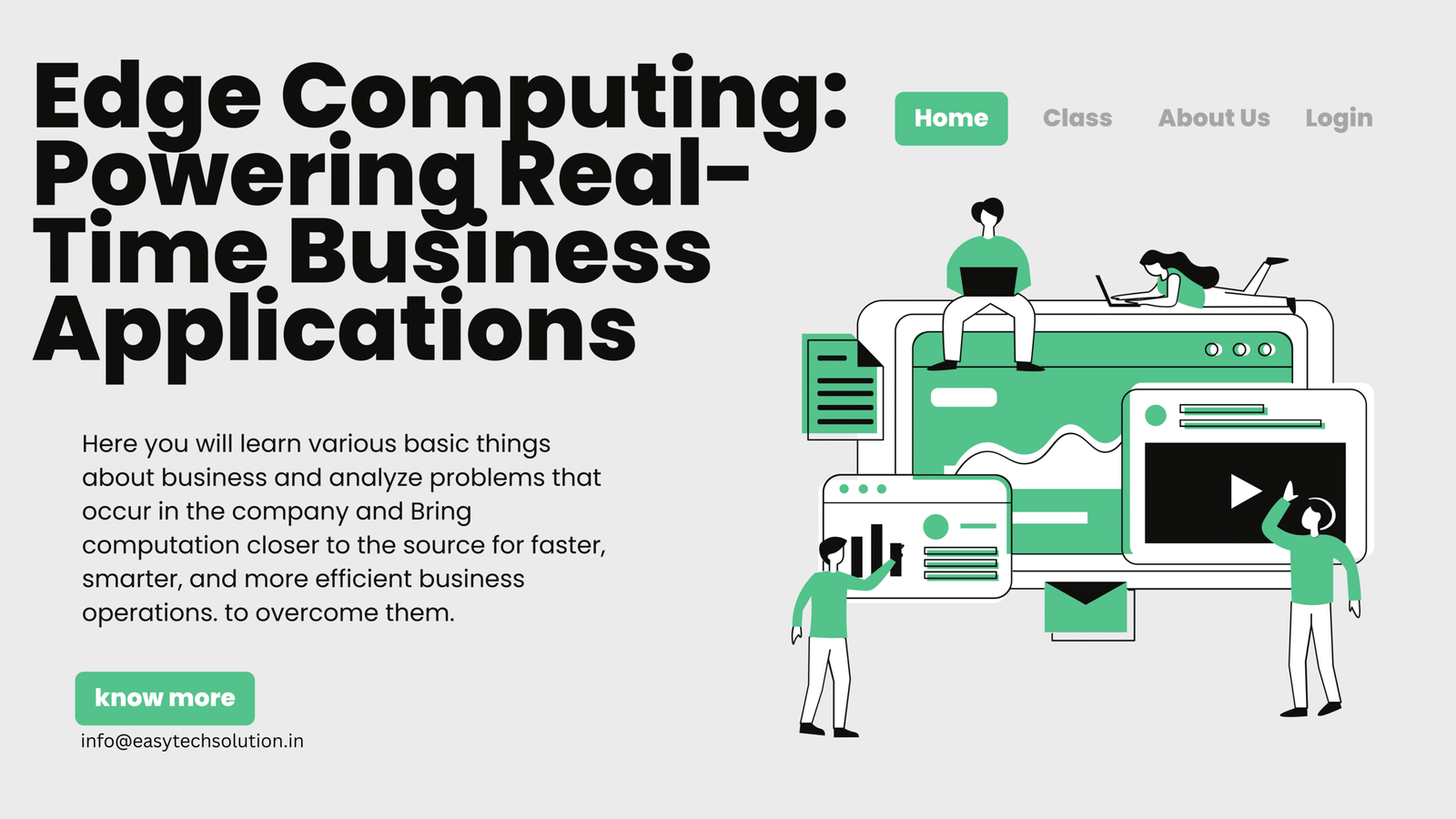
Enter edge computing — the next evolution of cloud technology. By processing data closer to its source, edge computing is revolutionizing how organizations manage information, deliver services, and enhance performance.
At EasyTechSolution, we help businesses leverage edge computing to power faster, smarter, and more responsive real-time applications.
What Is Edge Computing?
Edge computing is a distributed computing model that brings data processing closer to where it’s generated — whether that’s IoT devices, sensors, or local servers — instead of relying solely on centralized cloud data centers.
In simpler terms, rather than sending every piece of data to the cloud for analysis, edge computing performs computations at the network’s “edge.” This results in faster insights, reduced latency, and optimized bandwidth usage.
It’s an essential component of the modern cloud-edge ecosystem, enabling seamless real-time operations for industries like manufacturing, retail, logistics, and healthcare.
How Edge Computing Works
The process follows three key steps:
- Data Generation: Devices like sensors, cameras, and IoT systems collect data.
- Local Processing: The data is analyzed and processed at or near the data source (the “edge”).
- Cloud Integration: Processed insights or summarized data are then sent to the central cloud for long-term storage, reporting, or AI model refinement.
This distributed workflow minimizes latency and enhances the speed of real-time applications.
Key Benefits of Edge Computing
1. Real-Time Performance
Edge computing drastically reduces the time it takes for data to travel, enabling real-time decision-making. Industries such as autonomous vehicles, smart cities, and industrial IoT rely on this capability for instant response.
2. Reduced Latency
By processing data locally, edge networks eliminate the delay caused by cloud communication. This ensures smooth operations in time-sensitive environments like financial trading or medical monitoring.
3. Improved Security and Privacy
Sensitive data can be processed locally before being transmitted to the cloud, minimizing exposure and enhancing compliance with privacy regulations.
4. Bandwidth Optimization
Instead of sending massive data volumes to the cloud, edge computing filters and analyzes data at the source, reducing bandwidth usage and costs.
5. Reliability and Resilience
Even if cloud connectivity is lost, edge systems continue to operate independently, ensuring uninterrupted performance for critical systems.
Why Businesses Are Moving Toward Edge Computing
The rise of IoT devices, AI-driven analytics, and 5G networks has accelerated the adoption of edge computing. Organizations are realizing that centralizing all computation in the cloud isn’t sustainable for real-time operations.
With cloud edge benefits such as lower latency, enhanced privacy, and local data processing, enterprises can now deliver faster digital experiences, automate processes, and gain deeper insights — all in real time.
At EasyTechSolution, we integrate edge computing with your existing cloud infrastructure to maximize efficiency and innovation.
Real-World Applications of Edge Computing
- Smart Manufacturing: Real-time equipment monitoring and predictive maintenance.
- Healthcare: Remote patient monitoring and AI-assisted diagnostics at the edge.
- Retail: Personalized in-store recommendations and smart inventory management.
- Transportation: Autonomous vehicles using instant sensor data for navigation.
- Telecommunications: 5G base stations delivering ultra-low-latency connectivity.
These applications highlight how edge computing is transforming industries that depend on speed, accuracy, and continuous operation.
Edge vs. Cloud: A Perfect Partnership
Edge computing doesn’t replace the cloud — it enhances it. While the cloud handles large-scale analytics and long-term storage, the edge processes time-sensitive data instantly.
Together, they form a hybrid cloud-edge model, enabling businesses to achieve:
- Faster insights
- Improved efficiency
- Reduced costs
- Greater reliability
This combination is paving the way for the future of real-time business applications.
Challenges of Edge Computing
While powerful, adopting edge computing requires strategic planning and robust architecture. Key challenges include:
- Complex integration with legacy systems
- Security management across distributed devices
- Scalability of edge nodes and sensors
- Data synchronization between edge and cloud
Partnering with experts like EasyTechSolution ensures smooth implementation and maximum ROI from your edge investments.
Best Practices for Implementing Edge Computing
- Start with High-Value Use Cases: Focus on areas needing real-time processing.
- Leverage AI and Automation: Automate analytics at the edge to maximize speed.
- Ensure End-to-End Security: Protect data both in transit and at rest.
- Use Scalable Infrastructure: Choose edge solutions that grow with your business.
- Integrate Seamlessly with Cloud: Maintain a unified data flow between edge and cloud systems.
At EasyTechSolution, we design tailored edge-cloud architectures that empower organizations to achieve smarter, faster, and safer digital transformation.
The Future of Edge Computing in Business
As technologies like 5G, AI, and IoT continue to advance, edge computing will become a foundational element of enterprise IT strategies. By combining the agility of the edge with the power of the cloud, businesses can unlock real-time innovation at scale.
From manufacturing floors to healthcare systems, the cloud-edge synergy will define how enterprises operate, innovate, and grow in the coming years.
Conclusion
Edge computing is no longer just a technological concept — it’s a business enabler. By processing data closer to its source, organizations can achieve real-time responsiveness, improved security, and operational efficiency.
At EasyTechSolution, we help enterprises harness the full potential of edge computing and cloud-edge integration, delivering customized solutions that accelerate business transformation.
Take your business to the edge — and beyond.
🌐 Visit us: https://easytechsolution.in/
📩 Contact us: Contact EasyTechSolution