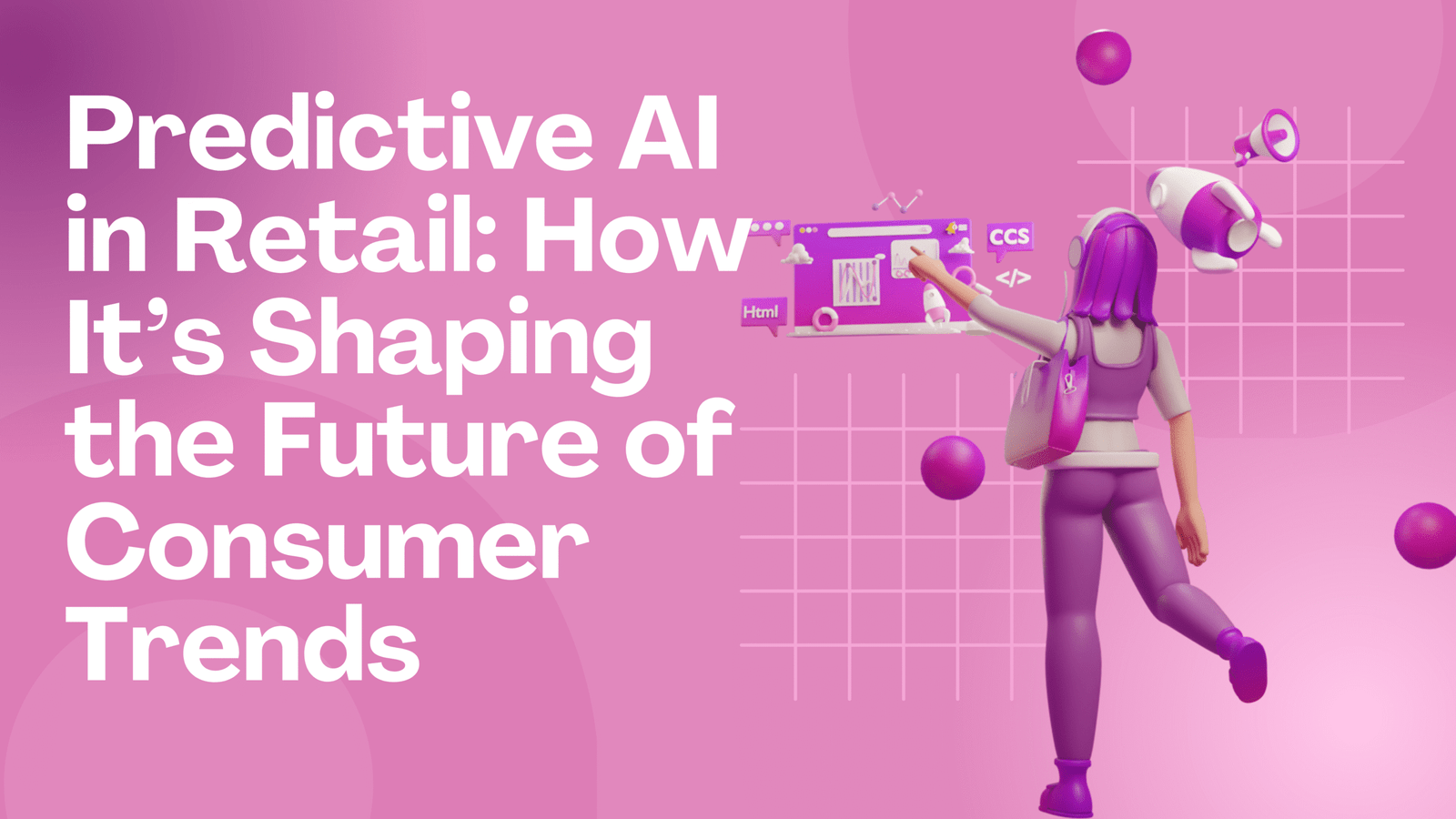
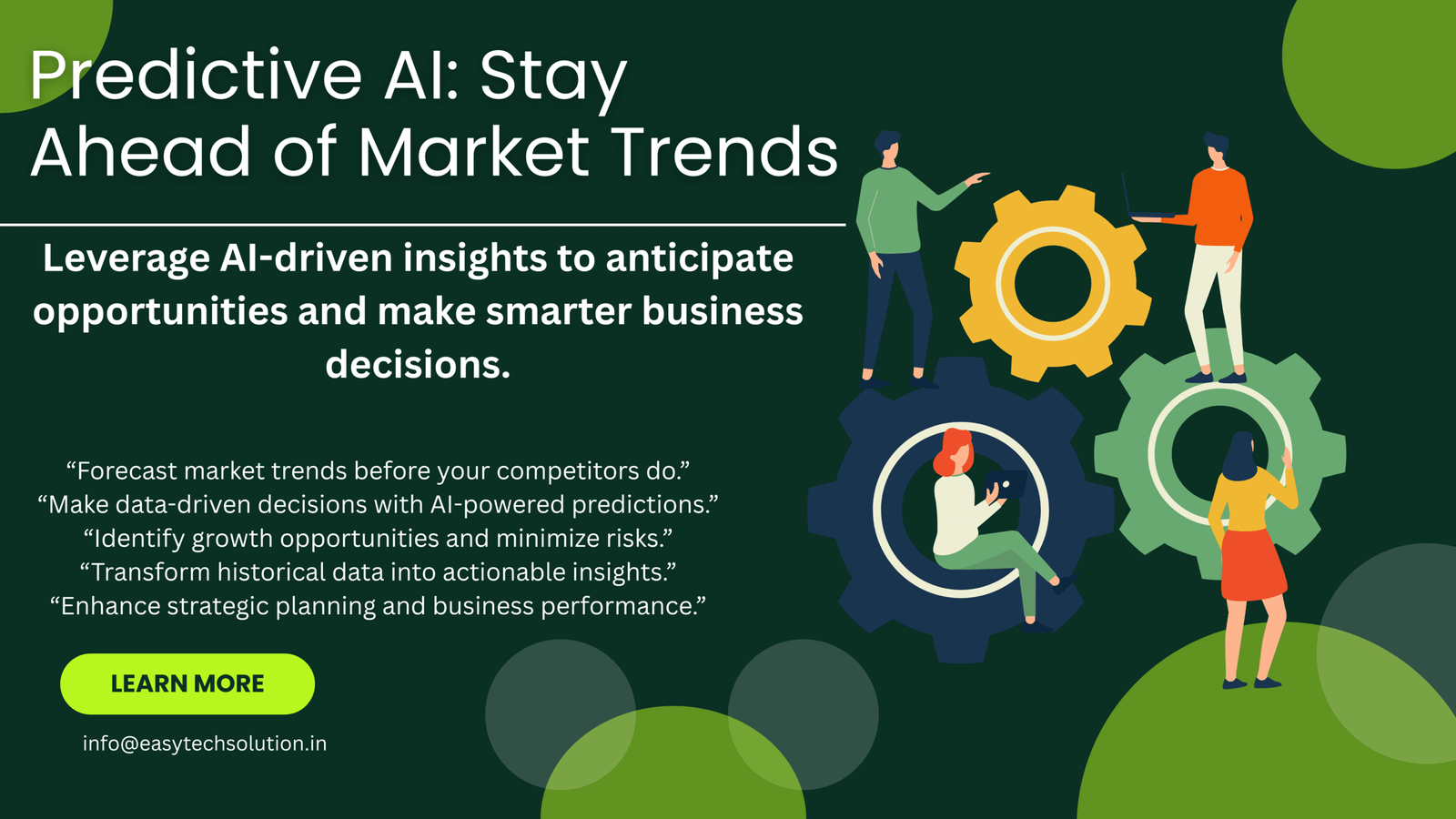
In today’s rapidly evolving digital landscape, businesses are no longer reacting to change — they’re predicting it. With Predictive AI, companies can now analyze patterns, identify upcoming market shifts, and make data-backed decisions long before trends become mainstream.
At Easy Tech Solution, we help organizations harness the power of AI forecasting and business trend prediction to gain a competitive edge in dynamic markets.
Understanding Predictive AI
Predictive AI is an advanced application of artificial intelligence that uses machine learning (ML), data analytics, and statistical modeling to forecast future outcomes.
Instead of relying solely on historical data, predictive AI analyzes real-time information, identifies correlations, and predicts potential scenarios — helping decision-makers stay ahead of the curve.
For instance, by analyzing social media conversations, purchasing patterns, and economic data, AI can predict emerging consumer trends, such as the next big product demand or technology wave.
Why Predictive AI Matters in 2025
In 2025, businesses are dealing with unprecedented amounts of data. The challenge is no longer data collection — it’s making sense of it.
That’s where Predictive AI comes in. It converts raw data into actionable foresight, allowing businesses to make smarter, faster, and more accurate decisions.
According to PwC, companies that use predictive analytics are five times more likely to make faster decisions than those that don’t.
How Predictive AI Works
Predictive AI operates through a structured process:
- Data Collection: Gathering structured and unstructured data from multiple sources — sales data, social media, CRM systems, IoT devices, and more.
- Data Cleaning & Preparation: Ensuring accuracy and removing inconsistencies.
- Model Training: Machine learning algorithms are trained on this data to identify trends and relationships.
- Pattern Recognition: The AI learns how variables interact to predict future outcomes.
- Forecasting: AI uses real-time and historical data to project future patterns — such as demand fluctuations, customer behavior, or market performance.
This enables organizations to make data-driven decisions with confidence.
Key Applications of Predictive AI in Business
Predictive AI is transforming industries by allowing leaders to anticipate market behavior and strategically plan ahead. Let’s explore the top use cases:
1. Sales Forecasting and Demand Planning
Businesses use Predictive AI to forecast demand, optimize inventory, and allocate resources efficiently.
For example, an e-commerce company can analyze seasonal sales data and customer engagement to predict which products will trend next quarter — ensuring the right stock levels.
At Easy Tech Solution, we help companies integrate predictive analytics into their CRM systems to improve sales accuracy and operational efficiency.
2. Financial Market Prediction
Predictive AI is revolutionizing stock market analysis, helping investors and analysts predict market movements with higher accuracy.
By combining historical price data with real-time news sentiment, AI systems can forecast market volatility and detect early signals of economic change.
For example, leading investment firms use AI forecasting to predict market downturns or growth spurts weeks before they occur.
3. Customer Behavior Prediction
Predictive AI enables businesses to anticipate customer needs and personalize experiences.
Retailers can identify when a customer is likely to make a purchase, while SaaS companies can predict customer churn before it happens — giving teams time to intervene.
Example: Netflix’s recommendation engine uses predictive algorithms to suggest content based on viewing history, resulting in 80% of watch activity coming from recommendations.
4. Supply Chain Optimization
In logistics and manufacturing, predictive AI helps forecast supply chain disruptions, material shortages, and delivery delays before they occur.
This foresight allows companies to proactively adjust sourcing strategies and maintain smooth operations.
5. Human Resource Planning
Businesses now use predictive analytics to anticipate hiring needs, predict employee attrition, and improve talent retention.
For example, AI can analyze workforce performance trends to identify potential skill gaps months in advance.
6. Marketing and Campaign Optimization
Predictive AI transforms marketing by identifying which campaigns will perform best, which customers will engage, and which channels yield the highest ROI.
By analyzing engagement data, AI can suggest when to launch campaigns or what offers are likely to attract more conversions.
7. Risk Management and Fraud Detection
Financial institutions leverage predictive models to detect unusual activity patterns and prevent fraud.
AI systems learn from historical transaction data, flagging suspicious activities before they cause damage.
Predictive AI in Different Industries
Retail and E-Commerce
Predictive AI helps retailers forecast product demand, optimize pricing, and enhance customer engagement strategies.
Example: Amazon uses AI to predict which products customers are likely to buy — enabling anticipatory shipping before the order is even placed.
Healthcare
Predictive AI models can forecast disease outbreaks, patient readmissions, and treatment outcomes.
Example: Hospitals use AI to predict patient recovery timelines, helping them allocate medical resources effectively.
Finance
Financial firms rely on predictive analytics to manage investment risks and predict loan defaults.
Example: AI models help banks identify potential defaulters before issuing loans — saving millions in losses.
Manufacturing
AI forecasting enables predictive maintenance — identifying machine failures before they occur.
This reduces downtime, increases productivity, and saves costs.
The Technology Behind Predictive AI
Predictive AI leverages several cutting-edge technologies:
- Machine Learning (ML): Core technology that learns patterns from data.
- Deep Learning: Enables advanced modeling of complex relationships.
- Natural Language Processing (NLP): Interprets human language data from sources like social media and reviews.
- Big Data Analytics: Processes massive datasets in real time.
- Cloud Computing: Provides scalability and accessibility for AI operations.
Together, these technologies make Predictive AI a powerful engine of foresight.
Benefits of Predictive AI for Businesses
✅ Proactive Decision-Making – Businesses can act on potential opportunities before competitors.
✅ Reduced Risks – Identify threats and mitigate risks early.
✅ Improved ROI – Optimize marketing, sales, and operations through accurate predictions.
✅ Customer Satisfaction – Personalize experiences and meet expectations efficiently.
✅ Increased Efficiency – Save time, money, and resources by automating forecasting tasks.
Real-World Example: Predictive AI in Action
A major retail client partnered with Easy Tech Solution to implement a predictive AI system for trend forecasting.
Within 6 months, the company achieved:
- 40% better demand forecasting accuracy
- 25% inventory cost reduction
- 20% higher sales during seasonal peaks
This success highlights how predictive AI can turn uncertainty into opportunity.
Challenges in Predictive AI Adoption
While predictive AI delivers remarkable advantages, businesses must address a few challenges:
- Data Quality: Inaccurate or incomplete data can reduce prediction accuracy.
- Integration Complexity: Aligning AI systems with legacy infrastructure can be complex.
- Bias and Transparency: AI models must be trained ethically to avoid biased outcomes.
- Skill Gaps: Many organizations lack the internal expertise to manage AI systems effectively.
At Easy Tech Solution, our AI experts simplify this process by offering end-to-end predictive analytics services — from data preparation to model deployment.
The Future of Predictive AI
By 2030, predictive AI will evolve beyond forecasting — it will simulate scenarios and autonomously recommend actions.
Key upcoming trends include:
- Explainable AI: Transparent and understandable AI predictions.
- Predictive Digital Twins: Virtual models forecasting real-world outcomes.
- AI + IoT Integration: Real-time predictions from connected devices.
- Hyper-Personalization: Forecasting user needs at the individual level.
Businesses that invest early in predictive AI will lead industries by anticipating market trends before competitors even see them coming.
Conclusion
In a world driven by rapid change, Predictive AI empowers businesses to move from reactive to proactive. It transforms data into foresight — helping leaders make smarter, faster, and more profitable decisions.
At Easy Tech Solution, we specialize in delivering AI forecasting systems that help organizations predict market trends, optimize operations, and future-proof their business strategies.
Call to Action
Ready to stay one step ahead of the market?
Partner with Easy Tech Solution and unlock the power of Predictive AI for your business today.